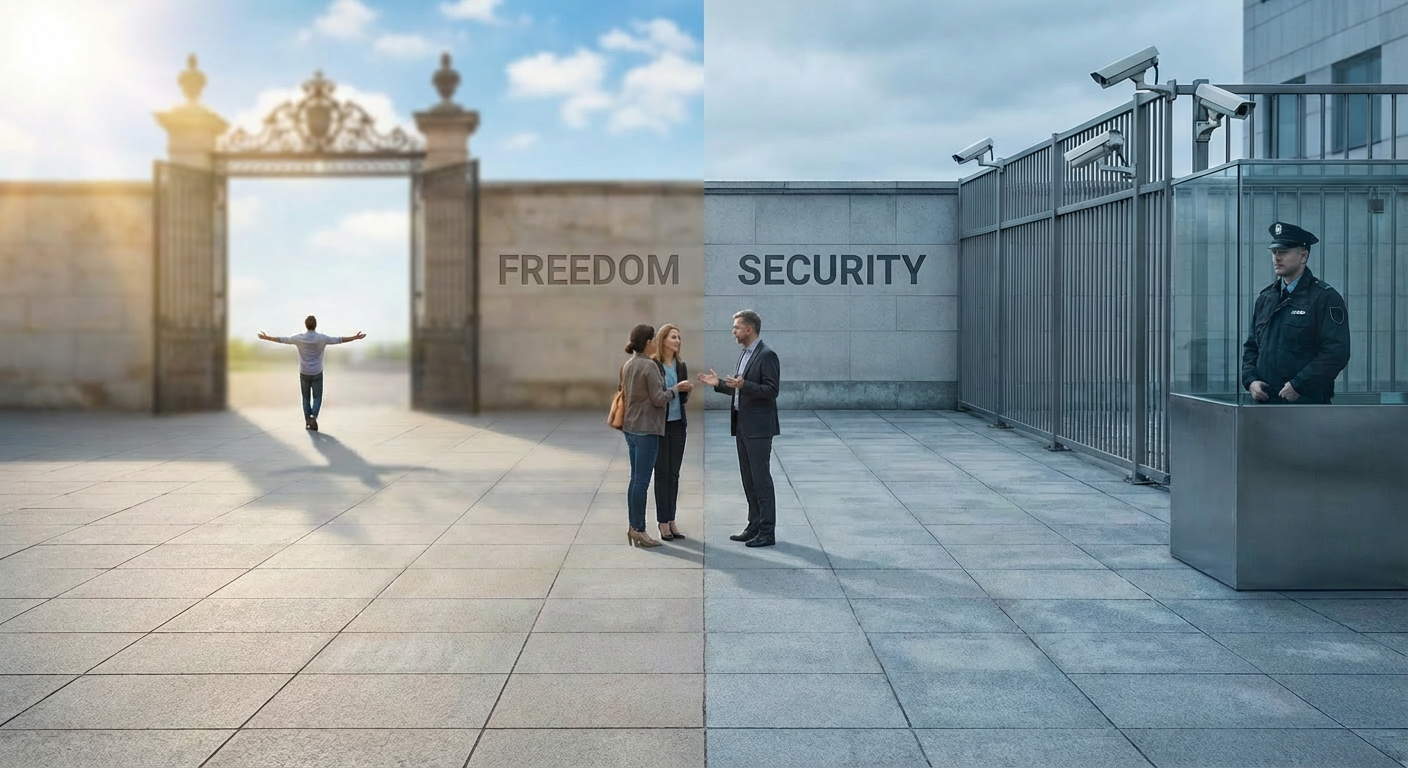
The debate between freedom and security sits at the very core of politics and society. It is not a new discussion, nor is it limited to any single country or political system. Every society, at every stage of its development, must decide how much personal liberty individuals should enjoy and how much authority the state should exercise in order to maintain order and safety. What makes this debate especially complex is that freedom and security are not opposites in theory—but in practice, they often compete.
Freedom is usually associated with rights that define modern citizenship: freedom of expression, freedom of movement, freedom of belief, privacy, and the ability to make personal choices without excessive interference. These freedoms allow societies to innovate, dissent, and evolve. They enable citizens to criticize power, challenge injustice, and shape public life. Historically, many of the rights people enjoy today were gained through long struggles against systems that prioritized control and stability over individual autonomy.
Security, however, speaks to a different but equally fundamental need. People cannot fully enjoy their freedoms if they live in fear—fear of violence, crime, instability, or external threats. Governments are created, at least in part, to reduce that fear by providing protection, law enforcement, and social order. In this sense, security is often presented not as the enemy of freedom, but as its foundation. Without safety, freedom risks becoming abstract, accessible only to those strong enough to protect themselves.
In the modern era, this balance has become even more difficult to manage. Technological advances have given governments unprecedented tools for monitoring, controlling, and influencing populations. Digital surveillance, data collection, biometric identification, and online regulation are now justified as necessary responses to terrorism, cybercrime, pandemics, and misinformation. At the same time, citizens are more aware than ever of how these tools can be misused, abused, or expanded beyond their original purpose.
Crises tend to sharpen this tension. During emergencies, societies often accept restrictions that would be unthinkable in normal times. The real controversy begins when temporary measures outlast the crisis that justified them. This raises a critical question: how much freedom should be sacrificed for security, and at what point does protection turn into control?
The “Freedom vs Security” debate is not about choosing one and rejecting the other. It is about deciding where the limits should be drawn, who sets them, and how they can be challenged. That is why this discussion remains one of the most important—and unresolved—questions in politics and society today.