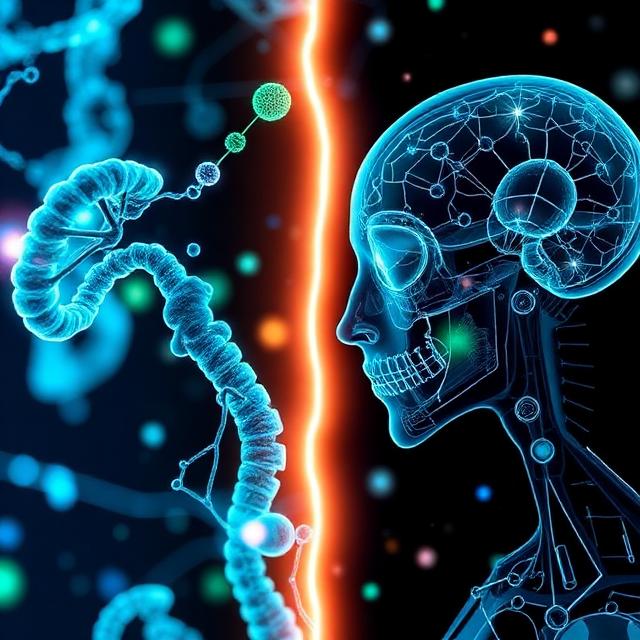
The 21st century is increasingly defined by technologies that once belonged to science fiction. Among the most transformative are biotechnology and artificial intelligence—two powerful forces reshaping industries, economies, and even the foundations of human identity. Both fields promise breakthroughs that could dramatically extend life expectancy, enhance productivity, and solve global challenges. Yet they operate in fundamentally different domains: artificial intelligence transforms how we process information and make decisions, while biotechnology transforms the biological systems that sustain life itself. The debate over which will have the greater long-term impact is not simply academic—it touches the future of health, society, and human evolution.
Artificial intelligence has rapidly moved from research labs into everyday life. Machine learning systems recommend what we watch, assist doctors in diagnosing diseases, detect fraud in financial systems, and power autonomous technologies. Large-scale AI models analyze enormous datasets in seconds, uncovering patterns and insights beyond human capacity. Governments and corporations invest billions into AI development, recognizing its strategic and economic value. The narrative surrounding AI often focuses on automation, productivity, and the augmentation of human intelligence. Supporters argue that AI will accelerate scientific discovery, optimize resource distribution, and enhance global connectivity. Critics, however, warn about job displacement, ethical risks, bias in algorithms, and the concentration of technological power.
Biotechnology, while sometimes less visible in daily headlines, may prove equally—or even more—revolutionary. Advances in gene editing, synthetic biology, and regenerative medicine allow scientists to manipulate DNA with unprecedented precision. Technologies such as CRISPR have opened the possibility of correcting genetic disorders at their source. Researchers are developing lab-grown tissues, personalized cancer treatments, and engineered microbes capable of producing sustainable materials. Biotechnology has the potential not only to cure disease but to redesign agriculture, reduce environmental damage, and fundamentally alter biological limits that have defined humanity for millennia.
What makes this debate particularly compelling is the depth of transformation each field represents. Artificial intelligence enhances cognitive capability—it changes how decisions are made, how quickly problems are solved, and how efficiently systems operate. Biotechnology, on the other hand, modifies life processes themselves—it changes how organisms grow, heal, reproduce, and adapt. One reshapes external systems; the other reshapes internal biology.
The implications extend far beyond innovation metrics. AI could redefine labor markets, governance, education, and warfare. Biotechnology could redefine lifespan, genetic inheritance, and ecological balance. Ethical considerations are central to both. Questions about algorithmic control, data privacy, and autonomous weapons parallel concerns about genetic modification, biosecurity, and unintended ecological consequences. Policymakers and scientists must navigate unprecedented territory where progress and risk advance simultaneously.
Importantly, these technologies are not isolated from one another. AI accelerates drug discovery, protein modeling, and genomic sequencing. Biotechnology generates complex datasets that require AI-driven analysis. The convergence of the two may unlock breakthroughs neither could achieve alone. Still, when considering which will more profoundly shape humanity’s long-term trajectory, the contrast becomes clear: artificial intelligence transforms intelligence; biotechnology transforms life.
The future may ultimately reveal that the true revolution lies not in choosing between them, but in understanding how their combined power will redefine the boundaries of what is possible for human civilization.


